
How Consyn has delivered millions in Duty Drawbacks for US importers
An estimated $15 billion in eligible duty drawback refunds go unclaimed every year in the US.

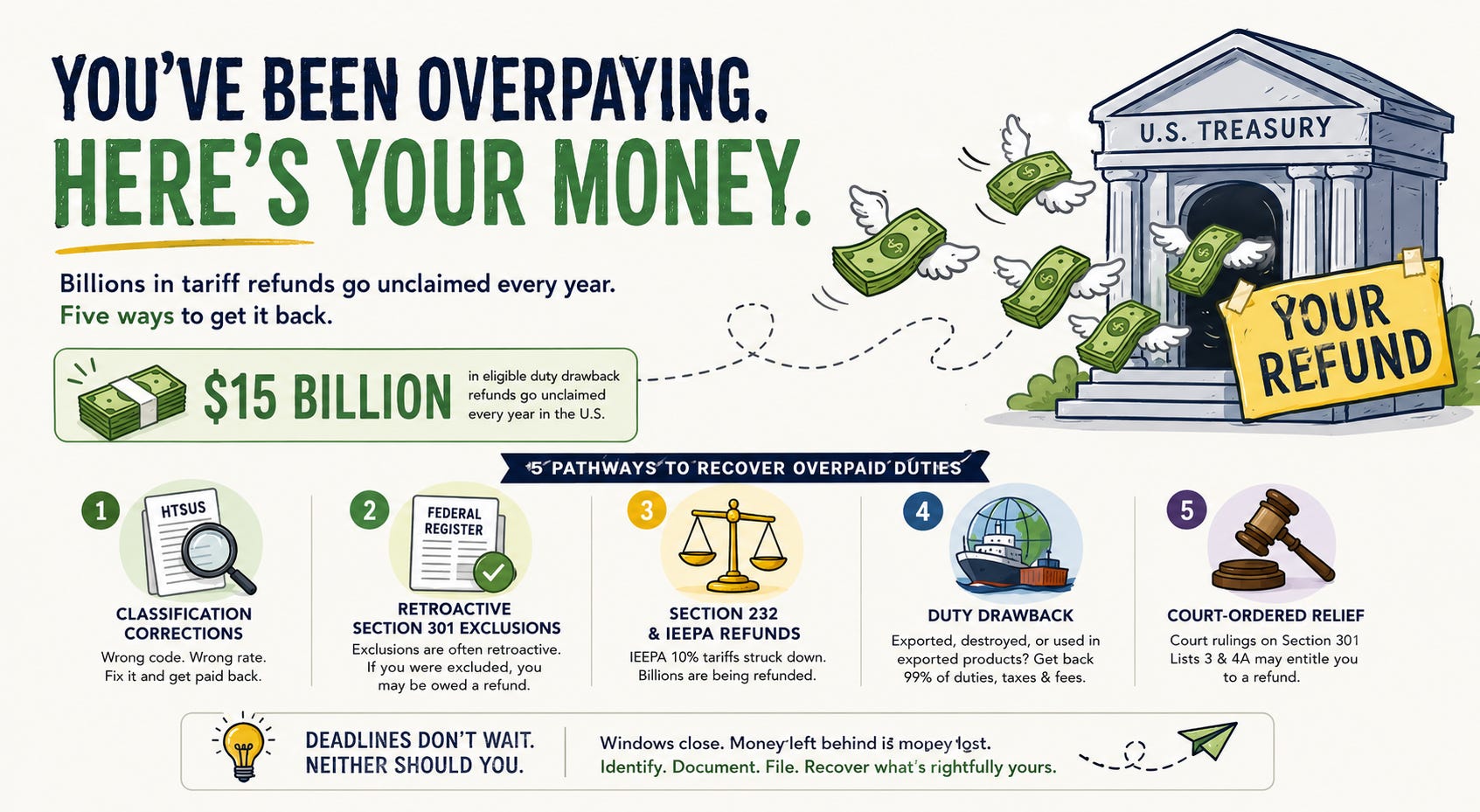
An estimated $15 billion in eligible duty drawback refunds go unclaimed every year in the US. The IEEPA refund — $166 billion owed to 330,000+ importers — is accruing $22 million a day in statutory interest while most companies haven’t filed. And misclassification? CBP doesn’t flag overpayments. Your broker doesn’t audit old entries. The money just sits with the Treasury.
If you import into the United States in any meaningful volume, some portion of the duties you’ve paid over the past five years is almost certainly recoverable. The question is whether you know which portion, under which mechanism, and before which deadline.
This article breaks down the five main recovery pathways, what they’re actually worth, and what the filing process looks like in practice.
Where Refund Money Comes From
Tariff refunds fall into five categories. Each has its own legal basis, its own deadlines, and its own filing mechanics. They don’t overlap neatly, and getting them wrong — or missing the window — is permanent.
1. Classification Corrections
The HTSUS runs to thousands of pages. The difference between two adjacent subheadings can mean the difference between duty-free entry and a 25% Section 301 assessment. Brokers file entries under default codes. Legacy item descriptions carry forward unchecked for years. Nobody reviews them until somebody does.
The statutory windows: 314 days from entry summary for a Post Summary Correction (PSC) on unliquidated entries. 180 days from liquidation for a protest on CBP Form 19. After that, the overpayment is gone.
In practice, a single misclassified product line — one digit off in the HTSUS — can represent six or seven figures in recoverable duty across a few years of entries. Classification errors are the most common source of overpayment and the most commonly missed.
2. Retroactive Section 301 Exclusions
USTR periodically grants exclusions from Section 301 China tariffs, and those exclusions are often retroactive. If your products were excluded but your broker didn’t catch the Federal Register notice, you’ve been paying List 1, 2, 3, or 4A duties on goods that should have entered at a lower rate. Recovery requires filing PSCs or protests depending on liquidation status — and matching your specific 10-digit HTS codes against the exclusion language precisely.
3. Section 232 and IEEPA Refunds
The IEEPA refund is the headline story of 2026. The Supreme Court struck down the tariffs in February. CBP launched the CAPE portal in April. As of May 12, 2026, CBP had approved refunds on 1.74 million entries out of 11.2 million submitted — a first-wave payout of $35.46 billion, though only ~$3 billion has actually been disbursed to importers so far.
The IEEPA refund covers the 10% ad valorem surcharge collected between April 5, 2025, and February 24, 2026. It does not cover Section 232 duties (steel/aluminium at 25%), Section 301 duties (China), or the Section 122 replacement tariff currently in force.
Section 232 has its own exclusion programme. If you filed for an exclusion, received it, but didn’t track it through to the entry level, the overpaid duties are recoverable — provided the entries are still within the protest window.
4. Duty Drawback
Drawback is not about correcting an error. It’s a statutory programme that refunds 99% of duties, taxes, and fees on imported goods that are subsequently exported, destroyed under CBP supervision, or used to manufacture exported products.
The look-back window is five years from import. Annual drawback claims in the US have grown from $838 million in 2017 to an estimated $3.9 billion by 2023, and the pace has accelerated sharply since. Yet an estimated $15 billion in eligible refunds still goes unclaimed every year — mostly because companies assume drawback is only for large oil and chemicals majors, or are put off by the recordkeeping requirements.
If you import and export in any meaningful volume, the probability that you have unclaimed drawback is high. A first claim covering five years of qualifying exports routinely produces refunds in the seven-figure range.
5. Court-Ordered Relief
Litigation at the Court of International Trade — particularly around Section 301 Lists 3 and 4A — has produced refund opportunities that extend beyond the named plaintiffs. If you paid duties on products covered by these rulings and filed timely protests or cases, you may have a claim. If you didn’t, the window may have closed.
Why This Money Goes Unclaimed
If recovering overpayments were straightforward, importers would do it themselves. In practice, successful refund work requires three things that rarely exist in one place.
Technical classification expertise — knowing the General Rules of Interpretation, the Explanatory Notes, CBP rulings, and CIT precedents well enough to build a defensible reclassification case.
Entry-level data analysis — pulling thousands of line items from ACE and broker systems, normalising the data, matching it against exclusion lists and HTS revisions, and identifying which entries justify the effort.
Procedural discipline — PSCs, protests, drawback claims, and prior disclosures each have their own forms, timing rules, documentation requirements, and appeal procedures. A missed deadline or an incomplete narrative converts a winning case into a denial.
Most importers have fragments of this capability in-house. Almost none have all three at the depth needed to maximise recoveries. Brokers, focused on clearing entries on time, are not positioned to perform historical entry audits. And the legal windows — 180 days for a protest, 314 days for a PSC, five years for drawback — close quietly while companies focus on the next shipment.
What the Numbers Actually Look Like
Refund work consistently produces results that surprise the companies involved, because the overpayments have been compounding invisibly for years.
A misclassified industrial component — one HTS digit off, pulling it into a Section 301 bucket it shouldn’t have been in — can generate $1m+ in recoveries across three years of entries, plus $300k+ in annual forward savings once the classification is corrected.
A retroactive 301 exclusion that a broker missed can sit unnoticed for two years. Matching the exclusion against accumulated entries routinely recovers $500k–$900k.
A manufacturer that exports 40% of finished output but has never filed a drawback claim is leaving money on the table every quarter. A first drawback programme covering five years of qualifying exports regularly produces an initial refund north of $2 million, with ongoing quarterly recoveries of several hundred thousand dollars.
Section 232 exclusions that were filed, granted, but never reconciled against actual entries: $500k–$700k in recoverable duties is common.
Missing or incomplete certificates of origin on goods that qualified for preferential duty treatment: $400k–$500k in recoveries once the documentation is reconstructed.
These are not edge cases. They are the standard outcomes of a thorough entry review for any company importing at meaningful volume.
The Deadlines That Matter Right Now
Every quarter that passes is another quarter of entries moving outside the recovery zone.
IEEPA refunds (CAPE): Phase 1 is live now. Covers unliquidated entries and entries liquidated within 80 days of submission. Later phases for reconciliation and drawback entries have no confirmed dates. The government’s appeal deadline on the CIT refund order is June 7, 2026.
Post Summary Corrections: 314 days from entry summary date. Entries from mid-2025 are approaching this window now.
Protests: 180 days from liquidation. For entries that liquidated in late 2025, the window closes in mid-2026.
Drawback: Five years from import date. The oldest qualifying entries from 2021 are expiring this year.
Section 301 exclusion claims: Depend on liquidation status of affected entries. Some windows have already closed; others remain open.
None of these deadlines announce themselves. CBP does not send reminders. Your broker will not flag them.
What To Do Next
Pull your ACE entry data for the last three to five years. Run it against current HTS classifications, applicable exclusions, and drawback eligibility. If you import in any volume, the probability that you have recoverable duty sitting in unfiled PSCs, expired protests, or unclaimed drawback is high.
If you don’t have the in-house capability to do this — and most companies don’t — get a refund assessment done. The recoverable amounts almost always justify the effort.
Consyn.ai helps importers identify and recover overpaid duties across IEEPA refunds, classification corrections, drawback, and exclusion claims — so nothing stays with the Treasury that shouldn’t.